A pool fence isn’t like other railings: it’s a safety barrier first, regulated by its own set of rules, and it’s the one part of a pool project that inspectors check line by line. Here’s what the codes actually require in 2026, where states differ, and how to spec a barrier that passes the first time.
The usual caveat applies double here: pool barrier rules come from the International Swimming Pool and Spa Code (ISPSC), state pool safety acts and local amendments — always confirm the exact requirements with your local building department before ordering.
The Five Rules Almost Every Jurisdiction Applies
1. Minimum height: 48 inches
The baseline barrier height is 48 inches measured on the outside face of the fence. That’s taller than a standard deck guard (36″) — a deck railing does not automatically qualify as a pool barrier. Some states set the bar higher: California commonly requires 60 inches under its pool safety provisions, and a few municipalities elsewhere follow suit.
2. The 4-inch rule
No opening in the barrier may allow a 4-inch sphere to pass — including the gap under the bottom edge (typically limited to 2–4 inches depending on the surface). Vertical clearances, panel joints, gate gaps: everything gets the sphere test.
3. Nothing climbable
The barrier can’t offer a foothold. That’s what disqualifies many railing styles around pools: horizontal cable is climbable by design, chain-link needs small mesh, and decorative scrollwork can act as a ladder. A frameless glass panel is the textbook answer — there is literally nothing to grab or stand on. (Full comparison in our glass vs cable vs aluminum guide.)
4. Self-closing, self-latching gate
Every access gate must swing away from the pool, close itself, and latch itself, with the latch release typically at least 54 inches above the ground (or on the pool side) so small children can’t reach it. This is the single most common inspection failure — usually a hinge tension or latch alignment issue, not a design one.
5. Complete enclosure
The barrier must fully separate the pool from the house and yard access points, with doors and windows opening into the pool area subject to their own alarm or barrier provisions in many jurisdictions.
Why Glass Has Become the Default Pool Fence
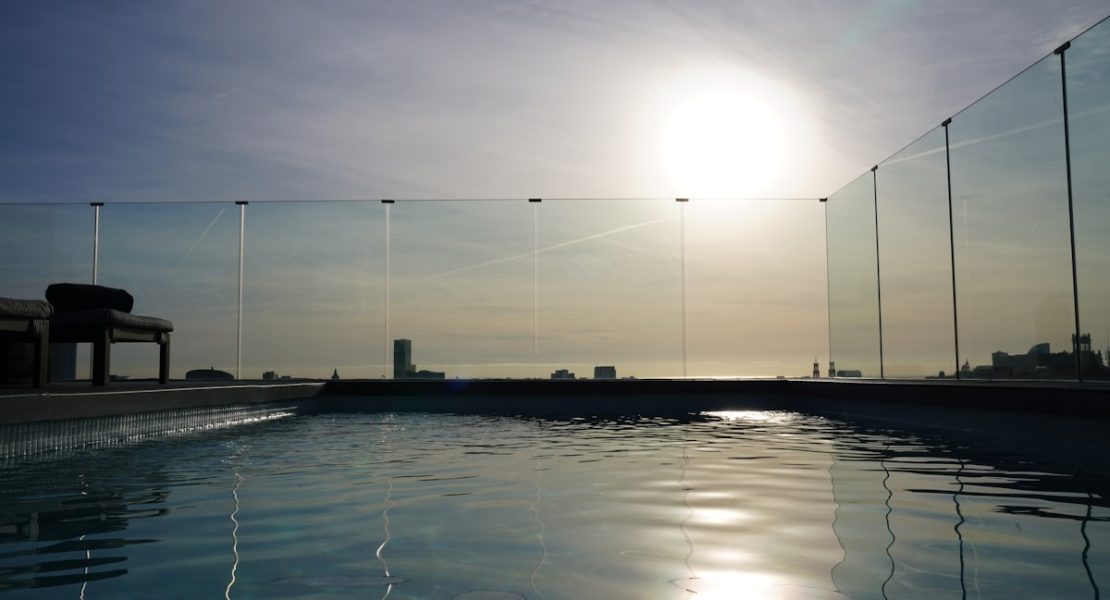
Run the checklist against a frameless glass system and it’s a clean sweep: 48″ (or 60″) panel heights off the shelf, no climbable members, sphere-proof spacing engineered into the spigot layout, and self-closing, self-latching gate hardware as part of the system — spring-loaded hinges, magnetic-style latches, the works.
Two more reasons it wins around water specifically:
- You can see the pool. A solid fence hides the water; supervision through glass is unobstructed — arguably the biggest safety feature of all.
- Pool chemistry is brutal on hardware. Chlorinated air pits standard stainless within a few seasons. Every ENO spigot, hinge and latch is machined from #2205 duplex stainless (PREN 35) — the marine-grade alloy built for exactly this exposure, with a 20+ year service life. The engineering details are on our frameless glass railing systems page.
Full product specifics — panels, gates, layouts — on our glass pool fence page.
What a Compliant Glass Pool Fence Costs
Materials for a complete frameless glass pool fence typically run $45 to $95 per linear foot delivered ($110 to $220+ per linear foot professionally installed). The gate kit — hinges plus latch — adds a few hundred dollars. Draw your pool enclosure in the free 2D configurator, place the gate, and the real number appears as you go; our cost guide breaks down every line item.
Passing Inspection: A 5-Point Pre-Check
- Height — 48″ minimum outside face (60″ where required); measure from finished grade, not the deck.
- Gaps — nothing passes a 4″ sphere, including under the bottom edge.
- Gate — swings outward from the pool, self-closes from any position, self-latches, release at 54″+.
- Climbability — no horizontal members or footholds within the barrier zone.
- Paperwork — some jurisdictions want glazing documentation for glass barriers (tempered safety glass certs); our team provides it, plus engineering support when your permit requires it. Height rules for the rest of your project are in our height requirements guide.
Frequently Asked Questions
How tall does a pool fence have to be?
The widely adopted baseline is 48 inches minimum, measured on the outside of the barrier. California commonly requires 60 inches, and local amendments vary — confirm with your building department. ENO panels come in 48″ heights with 60″ options for stricter jurisdictions.
Does a glass pool fence meet code?
A properly specified frameless glass system meets the standard barrier tests: height, the 4-inch sphere rule, no climbable members, and self-closing/self-latching gate hardware. Final compliance always depends on your local code edition and correct installation.
What are the gate requirements for a pool fence?
The gate must open away from the pool, close itself from any open position, and latch itself, with the latch release typically at least 54 inches above grade or positioned on the pool side. It’s the most inspected component of the barrier.
Can I use my deck railing as part of the pool barrier?
Only if it meets the pool barrier rules — which typically means 48″ height (taller than the 36″ deck standard), sphere-proof openings and no climbable members. Many deck railings don’t qualify as-is; a glass system specced at 48″ can serve both roles.
Ready to price your project?
Use our free 2D configurator to visualize your glass railing and get instant pricing.
Design my railing